Sunday, 24 March 2013

Moving over to the Gold Coast

Unfortunately Friday dawned with weather very typical of what Queensland has been experiencing for the past couple of months ... grey skies and a good possibility of rain.  Despite that, we decided to go for a drive into the Hinterland, the mountain range just north of Brisbane, and although the photos don't show off this area at its finest, it is a very beautiful part of the world.

The Glass House Mountains are a group of eleven hills that rise abruptly from the coastal plain on the Sunshine Coast.  The highest mountain is Mount Beerwah at 556m above sea level, but the most identifiable of all the mountains is Mount Tibrogargan (364m) which appears like a giant ape sitting by the roadside staring out to sea.  The mountains were named by explorer Captain James Cook in 1770.  The peaks reminded him of the glass furnaces in his home county of Yorkshire. 
The range was formed as molten lava cooled to form hard rock in the cores of volcanoes between 26-27 million years ago.  The cores of the mountains contain columns of comendite from lava which cools quickly into a hard rock.  The surrounding softer rocks have been eroded in the subsequent time, forming the spectacular volcanic plugs that remain today.


The Glass House Mountains are located in the traditional lands of the Gubbi Gubbi people.  In the Aboriginal legend the mountains are members of a family with the father being Mount Tibrogargan and the mother Mount Beerwah. All of the other mountains are sons and daughters with the eldest being Mount Coonowrin.
Tibrogargan, the father, observes that the sea is rising and asks that Coonowrin, the eldest son, help their pregnant mother to safety.  Terrified, Coonowrin instead flees.  Infuriated by his sons cowardice Tibrogargan pursues him and strikes him so hard that he dislocates Coonowrin's neck.
Once the danger passes Coonowrin feels tremendous guilt for his actions and asks his father, brothers and sisters for forgiveness but all wept with shame.  This is said to explain the many small streams that flow through the area.  Tibrogargan turned his back on Coonowrin and gazes out to sea refusing to look at his son Coonowrin who continues to hang his head in shame and weeps. 

We drove right by the base of Mount Tibrogargan so this will give you an idea of what these giant 'volcanic plugs' look like, just sticking right up out of the earth.


As you've probably gathered, Australian's are into "big things" and on my drive today there was another example --- the "Big Mower".


A little further along I had another very Australian experience - buying mangoes from a roadside stall, actually a trailor, fresh picked from his home near Gympie.


We had a picnic lunch at a place called Mary Carincross Reserve.   The reserve is positioned in the mountain rainforests of the Maleny region overlooking the Glass House Mountains.  I was lucky and the cloud cover did clear a little bit while we were having lunch, and if you look in the background you can just see some of the Glass House Mountains.


I had a visitor at lunch again today - a little bush turkey.


After leaving the mountains we went to visit a friend who lives in Caloundra.  Isn't this a beautiful tree - it's one of two giant scribbly gum trees that are in her backyard.


And being at Caloundra was great because it meant I was back at the beach again!  Moffat Beach is about a 5 minute walk from my friend's place, and fish and chips on the beach tonight was a great way to end the day.


The next day found me heading south/east from Brisbane, out to the coast again, and I'm now staying with a friend in Burleigh Heads which is on the Gold Coast.  Unbelievably we actually managed a bit of blue sky yesterday and I definitely tried to take advantage of it.

This is the main beach at Burleigh heads, looking south,


and looking north.  Off in the distance along the shoreline you can see the infamous "Surfer's Paradise".


Our drive yesterday had a very special end spot in mind, but en route we stopped at a little village called Bangalow.  If you didn't know better, you'd think that the village knew I was coming to visit and prepared itself especially for me.


After leaving Bangalow we stopped at a lookout with a fantastic view over a nearby valley and out towards the lighthouse at Byron Bay.   


Byron Bay has a population of about 5000 and Cape Byron, a headland adjacent to the town, is the easternmost point of mainland Australia.  Captain James Cook named Cape Byron after John Byron, circumnavigator of the world and grandfather of the poet, Lord Byron.


Cape Byron Light is an active lighthouse located at Cape Byron.  It is Australia's most powerful lighthouse, with a light intensity of 2,200,000 cd.  Construction of the lighthouse began in 1900 and it was completed in 1901.


From up at the lighthouse there is a marvellous view south along the coastline,


and in typical Cheryl fashion I could have spent hours on the rocks at the bottom just watching the waves.


Thursday, 21 March 2013

A bit of Brisbane history

Well the rain drops held off today, and although there wasn't any blue sky or sunshine of any description, I was at least able to be outside and explore Brisbane's city centre a little bit.

As I mentioned in the previous post, Queensland was proclaimed a separate colony in 1859, with Brisbane chosen as its capital, although it was not incorporated as a city until 1902.  Today I went on a little, self-guided walking tour of the area that is essentially Brisbane's CBD.

St. John's Cathedral is the mother church of the Diocese of Brisbane, which was created in 1859.  It was the vision of Bishop Webber, the 3rd Bishop of Brisbane, to build an Anglican Cathedral here and St. John's Cathedral emerges as a mixture of French and English Victorian Gothic Revival styles.  The Cathedral was begun in 1901 but actually only finished a few years ago, having been built in three stages: 1901-1910, 1964-1968 and 1989-2009.  The Cathedral houses needlework, intricate wood-carvings, stained glass windows and the only fully stone-vaulted ceiling in Australia.  St. John's Cathedral is likely to be the last neo-Gothic building to be completed in the world.


With the foundation stone laid on Anzac Day 1928, and built entirely from local materials, the Freemasons Ann Street Memorial Centre is a Memorial dedication to those who gave their lives in World War I and subsequent conflicts.


St, Andrew's Uniting Church is an excellent example of Romanesque-Byzantine architecture.  The land where the original church stood was taken by the railway and a competition was called for the design of the new church.   The design was simple and severe and did not find favour with many, who had expected a Gothic style church.


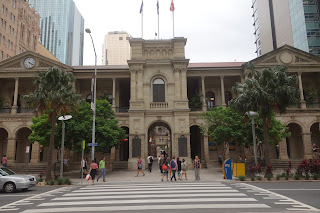
The Central Railway Station opened in 1889 as a temporary structure made of timber and corrugated galvanized iron, but then an elegant new station was constructed and opened in 1899.


Brisbane's main war memorial and Shrine of Remembrance was dedicated in 1930.   The 18 columns of the Shrine symbolise the year 1918, when hostilities ceased.  The stairs linking the Shrine with the parkland below have 19 on one side and 18 on the other - 1918, the year when the Great War ended.


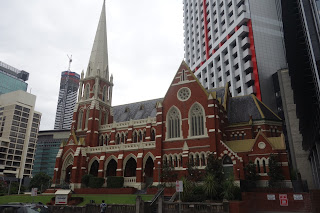
Albert Street Uniting Church (opened in 1889) is built in the decorative Gothic style of architecture to harmonize the style with the requirements of a tropical climate.  The most prominent feature of the external design is the spire, rising to a height of 42 metres from the street.


Officially opened in 1930, the heritage-listed City Hall is seen as the heart of Brisbane.  The City Hall was once the tallest building and it has an imposing 70m clock tower (rising 91m above ground level), based on the design of the St. Mark's Campanile in Venice, Italy.  The four clock faces on each side of the tower are the largest in Australia.  Above the main entrance is a bronze awning and the doors are also made of bronze.  Lions heads are found above these columns.


This statue to commemorate the first settlers in Queensland can be found on the grounds in front of the City Hall.


The former Queensland Government Treasury Building is located in Brisbane.  It was built in three stages from 1886 to 1928 and the entrance features a grand staircase.


The Lands Administration Building was built between 1898 and 1899.


Although not operational any longer, the building still has one of its original elevators (lifts) - the first electric lift in Brisbane.


What is now the Commissariat Store Museum was once a convict built storehouse built for the convict settlement in 1829.  It is one of only two surviving buildings from the convict period in Queensland and is one of only four surviving commissariat buildings in Australia. 


This is the old State Library of Queensland building.  It was built in 1879 and was originally constructed for the Queensland Museum that stayed in the building until 1899.


Parliament House in Brisbane is the home of the Parliament of Queensland housing the Legislative Assembly.   The building was built in 1864-1867.


Queensland's first Government House is also located in Brisbane.  The building's construction was the first important architectural work undertaken by the newly formed Government of Queensland in 1860.  The government residential building was constructed to accommodate the first Governor of Queensland, Sir George Bowen and his family.  On 22 May 1860, the first Queensland parliament met and one month later a vote to fund a new government house was successful.  The site chosen for the building was a high point overlooking the Botanic Gardens.  There was an issue with the building being built in Brisbane, as the capital of Queensland had not yet been decided.  The front half of the building contained the Governor's public and private rooms while the rear housed the service section.  The front of the house had a plain design without displays of grandeur so as not to affront politicians and country citizens.


The old Government Printing Office was built in 1874 and in 1886 it and the Parliament House were connected via an underground cable.   This provided the Parliament House with an electrical supply, the first for any Parliament House in Australia.


The Mansions were built in 1889.  Constructed of red brick in the 'Queen Anne' style, the building was well suited to the subtropical climate in Brisbane.  The cats that sit on top of the building were crafted  from New Zealand limestone.  


There is an old story in Brisbane that Devils have run amuck - specifically the seven devils who normally look down from the old Government Printing Office - and these devils have caused great alarm to the two cats further up the street on the Mansions building where they cling for dear life.


The Cathedral of St. Stephen is located right in the heart of the city and built between 1864 and 1922, with extensions made in 1989.  You can also see St Stephen's Chapel on the right side of the photo.  The chapel was built between 1847 and 1850,  the first Mass was celebrated in the completed building in 1850 and in 1859 it became the cathedral for the first Bishop of Brisbane.  It is the oldest Catholic church in Queensland.


In this building General Douglas MacArthur established his headquarters on 21st July, 1942, and here he formulated the initial plans which led to victory over the Japanese forces on 15th August, 1945.  The forces under his command comprised navy, army and air personnel of Great Britian, United States of America, Australia, New Zealand and Netherlands East Indies.


Brisbane's General Post Office opened in 1872.  The original plans provided for a handsome clock tower however this work did not proceed.


Customs House was originally used for the collection of customs duty and was both completed and opened in 1889, when Queensland was a British colony.


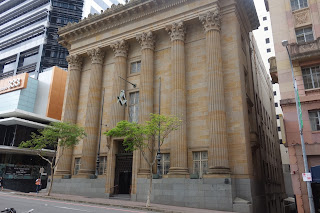
The former head office of the Qld National Bank dates from the 1880s - Brisbane's 'Belle Epoch'!  So grand was its banking chamber that the building was often referred to as 'Drury's Temple' in deference to the Bank's General Manager Lt.-Colonel E.R. Drury.  Built in the Classical Revival style with Queensland sandstone used in the construction of the building and New Zealand limestone features in the imposing Corinthian columns.


Also, when I was walking around I came across this piece of public art, all made from various pieces of recycled metal objects.  I thought they were wonderful.