Monday, 13 May 2013

Back in Melbourne - and getting ready to go

After leaving Bendigo I did come back to Melbourne but only for one day, and then I was off again, back to the Yarra Valley for another quick visit with my friends there.  It was a lovely visit - good food, good wine and the best company!!  And while we were sitting out in the backyard enjoying a bit of autumn sunshine, several of these lovely king parrots came to keep us company.


Now I am back here in Melbourne, and will be here until I leave Australia later in the week.

They say that Melbourne is the city that can give you all four seasons in one day, and today was a clear example of that!  I started out this morning and after only walking a couple of blocks I returned home to leave my jumper behind as I was just too hot!  While I was out this afternoon though I got caught in a thunderstorm, then a hail storm, then the temperature dropped at least 10 degrees,... and then to end my walk the sun came out again.

Despite the weather I was able to get out and enjoy another of Melbourne's self-guided walks - this one called "Elegant Enclave" and it took me into East Melbourne, looking at elaborate ironwork, classic columns and lofty verandas from the Victorian era.

Hepburn Terrace was built in 1874 and is a fine example of the Victorian homes that define inner Melbourne.


And another mansion is just a bit further up the street.


One of Melbourne's oldest homes is this 1856 terrace,


while behind the hedge is gracious "Braemar", dating to 1865.


This grand house, built in 1860, is now four apartments and it was home to Sir Benjamin Benjamin, Mayor of Melbourne in the 1880s.


These two neighbouring homes are from the 1880s and I loved the mass amounts of iron lacework on them.


This little cottage/house was part of an early farm and is now buried within the middle of an urban suburb,


while just a little bit further along the street you can see these wonderful Art Deco flats.


The next block contains this house that is a converted post office from the 1920s,


and on the other side of the street "Georgian Court" was built as apartments in 1860.


Next along is the 1865 home of Melbourne's first surveyor, Robert Russell.


"Queen Bess Row" was built in 1886 and is now three private homes,


and next door to Queen Bess Row is "Sydenham House" which was built in 1856 as a girls' school.


"Dorset Terrace" has front doors that are very unusually placed --- they are diagonally across from the entrance gates.


Cairns Memorial Presbyterian Church was converted into apartments after a fire in the 1980s and the building is now an amazing mix of old and new.


Another example of old and new is this Victorian home.  On the right is the original house while the left side is its contemporary addition.


On the left side this 1868 home has an unusual opera-box-style balcony and like the other homes beside it, it looks two-storied but, because of a slope, it is really three-storeys at the rear.


A little bit further down the block is this house, build in 1867.


This 1873 mansion with the arched veranda has been a private hospital and rooming house, and it is now a private home.


In 1888, "Nepean Terrace" was the home of actor Frederick Baker who died on stage at the Princess Theatre and whose ghost, Federici, is said to haunt the theatre.


This was the townhouse of Constance Stone, who became Australia's first woman doctor in 1890,


and "Little Parndon" was home to Eugene von Guerard, prominent artist and teacher in the late 1800s.


Artist-author Norman Lindsay (who wrote The Magic Pudding) courted his wife Kate Parkinson in this house in the 1890s,


and behind this white wall is the former home of Picnic at Hanging Rock author Joan Lindsay and husband Daryl Lindsay, once director of the National Gallery of Victoria.


"Canterbury Terrace" was built in 1878 and it is Melbourne's longest terrace, with 16 homes.


"Magnolia Court" was Ormiston Ladies College.  In the early 1900s, Magnolia Court was home to those involved in Melbourne's theatre and the early days of the Australian Ballet.


This terrace house was home to Peter Lalor, who lead miners in the Eureka Stockade uprising at Ballarat in 1854.


This 1861 bluestone home has been dubbed 'The Gothic House'.  It was designed by architect Joseph Reed (who designed Melbourne Town Hall, State Library and Royal Exhibition Building) for deputy surveyor-general Clement Hodgkinson (who designed the Fitzroy and Treasury gardens).


Across the street from 'Gothic House' is "Fairhall", an elegant 1860 townhouse which is now an art museum.
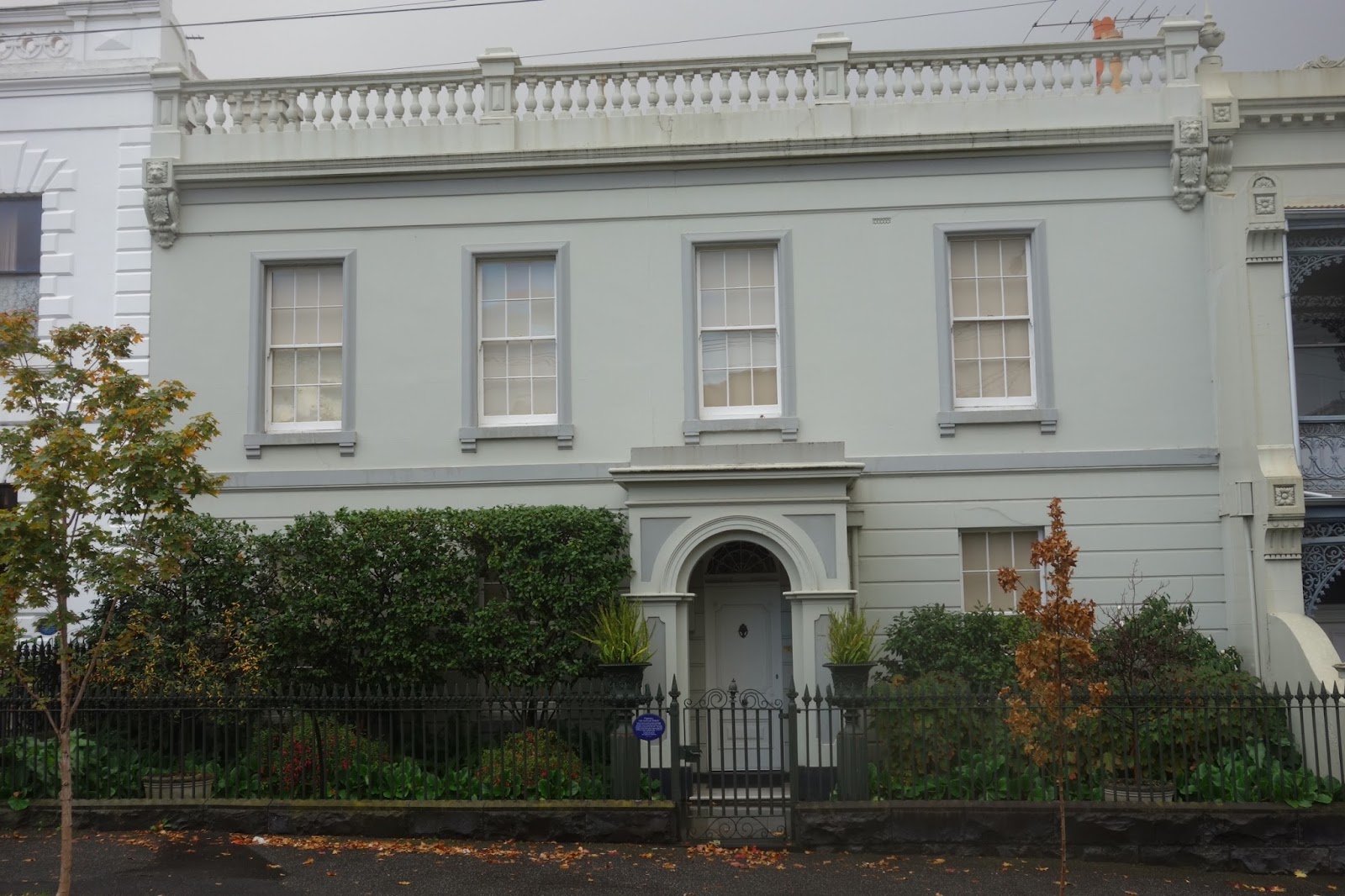

"Cyprus Terrace" was designed to look like two grand houses but it's actually four homes.


"Bishopscourt" was completed in 1853 and is the oldest remaining house in East Melbourne.  Originally built for Bishop Charles Perry, first Anglican Bishop of Melbourne, it also doubled as Victoria's Government House in 1874-76.  It has been the residence for all Melbourne's Bishops and Archbishops since its completion.  This house is actually completely private and enclosed by a long black fence that goes all around the block - so I had to take this photo through a little hole in the fence.


My walk today actually started and ended by going through Treasury Gardens and Fitzroy Gardens.  I haven't highlighted them for you in this post, but if you look back at some of my previous posts from Melbourne you can find out a lot about both these beautiful gardens in them.


Now as you could probably see from the photos, I really did walk through the gambit of weather conditions this afternoon, but as I said, my walk ended with beautiful sunshine again... a wonderful way to end.

Thursday, 9 May 2013

Exploring more of Bendigo

Sacred Heart Cathedral is one of Australia's largest churches and the second tallest after St. Patrick's Cathedral in Melbourne.  It is an exceptionally large church for a provincial city cathedral - and work first began on it in 1895.  The large pipe organ, built by Bishop & Son of London, was installed late in 1905...and then construction ceased for several years.  It wasn't until 1945 when work on the cathedral recommence and it was completed in 1977.  Sacred Heart Cathedral is 75 metres long and has a ceiling height of 24 metres.  The main spire is 87 metres high.


Although I knew that many Chinese had immigrated to Bendigo at the time of the goldrush, I was very surprised at well this history has been documented.  The Golden Dragon Museum tells how the Bendigo Chinese community has influenced the proud history of Bendigo.  The Chinese arrived in Bendigo during the goldrush of the 1850s and established communities in the region.  In 1871 the Chinese community joined the Bendigo Easter Procession for the first time, and in 1892 a local newspaper reported the first appearance of a dragon in the Bendigo Easter Procession. 

Loong (dragon) is the oldest Imperial (five clawed) Dragon in the world.  He made his first appearance in 1892 and continued to walk through the streets of Bendigo every year until his retirement in 1970.  He was created in the City of Fatt Shan on the Pearl River near Canton in China.  In his original state Loong was about 60 metres long and was built of silks, mirrors, bamboo and papier-mache.  In 1901 Loong travelled to Melbourne to celebrate Federation and in 2001, Loong made the journey back to Melbourne to march in the Centenary of Federation parade.  In 2007 Heritage Victoria added Loong to the Victorian Heritage Register, receiving the State's highest level of heritage protection.
Loong is the oldest surviving Imperial Dragon in the world and he requires 22 carriers and is 29 metres long.


Sun Loong (new dragon) was brought from Hong Kong to replace Loong in 1970.  Sun Loong is the longest Imperial Dragon in the world, being over 100 metres in length and requiring 57 carriers.  Before he appeared in 1970 he was blessed and brought to life by 101 years old Mr. James Lew dotting his eyes with chicken blood.  Sun Loong was awakened to accompany Loong in his last Bendigo Easter procession in 1970.


Bendigo Pottery is Australia's oldest working pottery factory.  Established in 1858 the pottery has operated continuously from the current site in Bendigo since 1863.
Bendigo Pottery has the most significant collection of ceramic wood fired kilns left in the world. There are 10 kilns in total, comprising 5 bottle kilns, 3 circular kilns and 2 rectangular kilns.  Although no longer used, the old kilns are now part of a very informative interpretive museum.  The last firing of a wood fired kiln on the site was 1989 and the kilns are all listed on the Victorian Heritage Register.


Bendigo Pottery is still made on the same site (in a slightly more modern factory), using a range of different production techniques including hand throwing, slip casting, jolleying and pressing.  All product is now fired in natural gas fired kilns.  Also on the site of Bendigo Pottery is the original General Store from Moliagul, a little village about 50 kms west of Bendigo.  The largest gold nugget found in Australia and named 'The Welcome Stranger' was discovered at Moliagul on the 5th of February, 1869.  It weighed 73 kgs and was 53 cms long and 25 cms thick.  John Flynn was also born at Moliagul - the man who founded the Royal Flying Doctor Service.


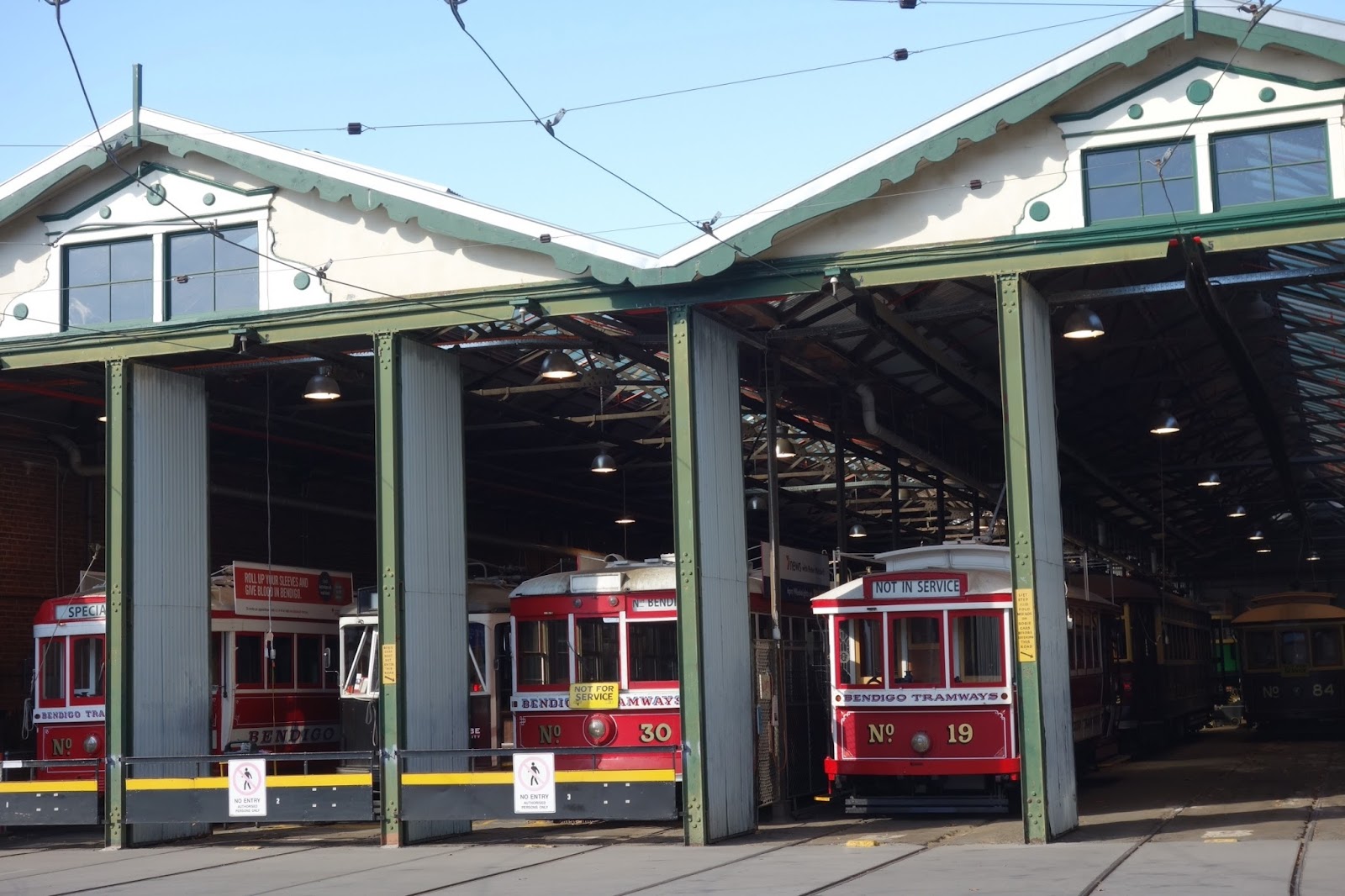
Trams have long been a form of public transportation in Bendigo.  The first trams in Bendigo were battery operated, but only lasted three months before being withdrawn due to their unreliability.  A steam tram system commenced operation in 1892 and lasted until 1902, and then electric trams commenced in 1903.  In 1972 the Bendigo tramways were closed.
Today Bendigo Tramways operates as a tourist tram - and you can sit back and listen to many interesting stories about the city and its goldfields.


Australia's oldest operating Tram Depot is also in Bendigo, and the workshop carries out restoration works on heritage trams for other depots and museums around Australia and overseas.


Of course a visit to Bendigo probably wouldn't be complete without a visit to a gold mine... and although I was a little reluctant I did actually find myself underground for a while today. 
The Central Deborah Gold Mine operated from 1939 to 1954 during which time it yielded almost one tonne of gold from its mining operations which would be worth around $48 million in today's prices!
Central Deborah was one of the last two commercial mines to cease operation in Bendigo and today it operates mine tours.
Even though I didn't go very deep underground - just to Level 2 which is about 65 metres underground - walking through the tunnels with only a light on my hard-hat certainly did give me an indication of what the mining conditions must have been like.


(an underground loo)


It was also really interesting wandering around the surface of the mind and exploring things like:
- the trestle way which was used to trolley the rock collected from underground.  Gold bearing quartz was placed into the ore bins to be transported for processing, while waste rock was discarded off the end of the trestle way.


- the cages attached to the cables passing through the poppet head were not only used to transport miners above and below ground but were also used to haul rock, or ore, in trucks from underground to the trestle way.


After being underground I thought some very fresh air was in order, and so I had lunch by Lake Weeroona.  In 1873 Mayor Duggall McDougall had the vision to turn a barren, dusty eyesore created by the mining around a section in the Bendigo Creek into an ornamental lake and reserve - Lake Weeroona.


Built by the Bendigo Gas Company in 1860, Bendigo Gas Works operated continuously until the introduction of natural gas in 1973.  The former Bendigo Gas Works is the only coal gas production plant to survive in Victoria.  The plant represents 113 years of coal gas production and major plant components including twentieth century modifications remain intact.  The works were the last and most technologically complete coal-gas production plant in Australia.


St. John's Presbyterian Church was first established in 1859 but the original church was destroyed by fire.  This second church was built in 1897.


All Saints Anglican Church was Bendigo's first church, built in 1852.


And another bit of interesting Bendigo history - Bendigo is home to the original Myer store.  Myer's is a department store here in Australia (Canadians you can think HBC) - Sidney Myer arrived in Australia from Kritchev in 1899.  In Bendigo, in 1900, Sidney Myer opener his first store and in 1902 the Myer Bros. business was registered.  Since then the Myer business has grown to more than 60 stores across Australia.


George Lansell arrived in Bendigo (from England) in 1853 and opened a butchery, soap and candle factory and tallow chandlers business.   He became interested in deep reef mining, and one of his mines was sunk to a record depth of 3719 feet.  He died in 1906 and his critical influence on the development of Bendigo gave him the nickname of the "Quartz King".  In 1906, citizens erected an over-life size bronze statue of him holding a lump of quartz on a granite base.


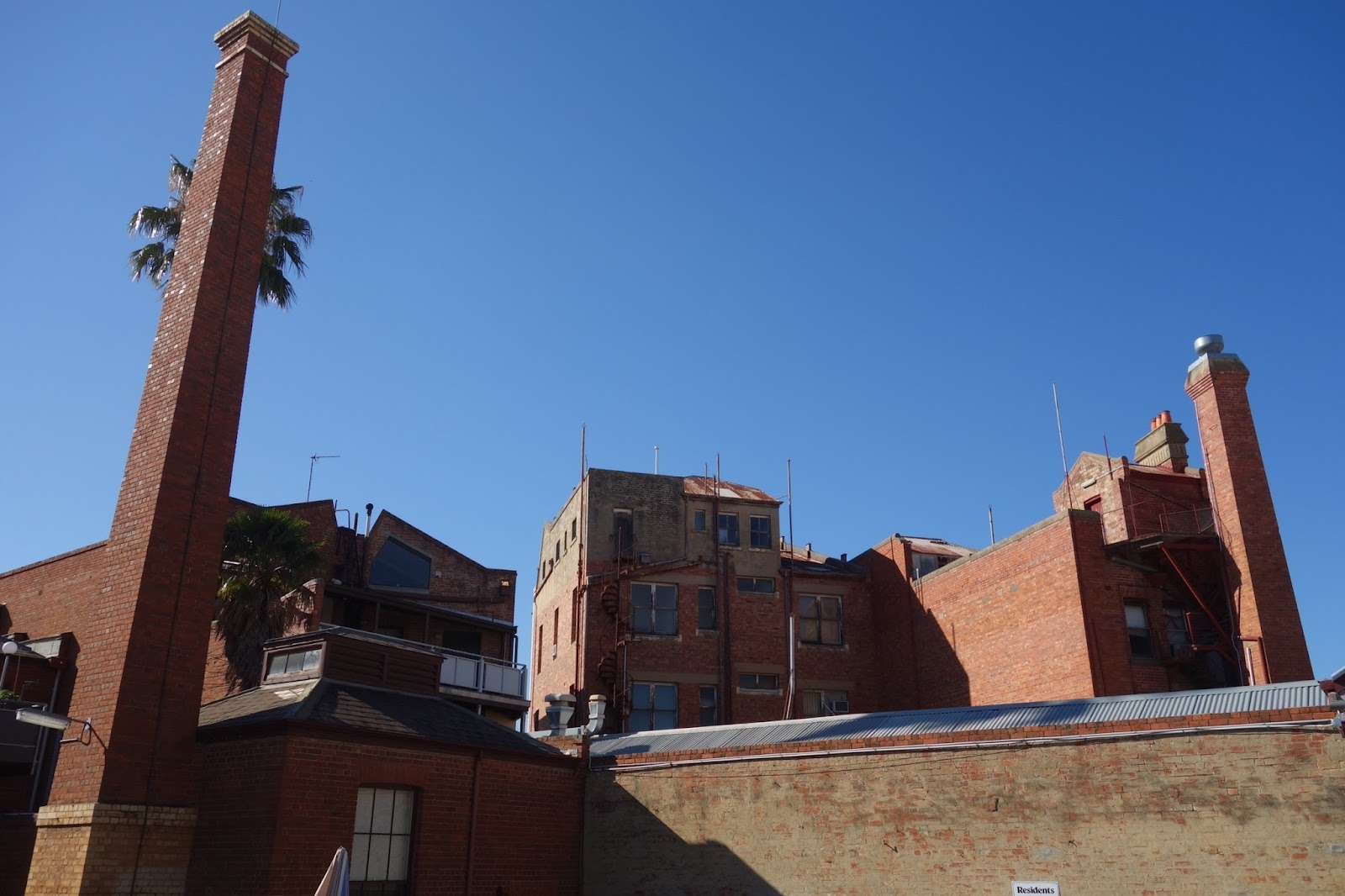
Just before leaving Bendigo today I went back to the CBD area to look at some of what are now primarily courtyards around businesses and apartment buildings, but what used to be the old gold smelters.  It's really quite interesting to see all the old chimney's.


And just before I go I thought I'd show you my favourite hang-out in Bendigo.  This was once the Union Bank of Australia, built in 1857 ... and is now a wine bar called the Wine Bank.  There are 1023 different bottles of wine inside!