Wednesday, 8 May 2013

Exploring a new location - Bendigo

Bendigo is a major regional city in the state of Victoria, located very close to the geographical centre of the state and approximately 150 kms north-west of Melbourne.  It is the second largest inland city and fourth most populous city in the state.  The population is approximately 90,000 and people living here in Bendigo are known as 'Bendigonians'.


Its first official name was Castleton after the mining town Castleton, Derbyshire, England.  Sandhurst, after the Royal Military Academy Sandhurst, became the official designation for the settlement in 1854, although the nickname of "Bendigo" remained popular.  After a plebiscite (referendum) in 1891 the city was renamed to the more popular "Bendigo", although the name Sandhurst has a legacy and is still used by a number of organizations.


Like Beechworth, Bendigo was built from gold.  Bendigo is one of the most significant Victorian era boomtowns in Australia.  Gold was discovered in 1851 at The Rocks on Bendigo Creek and the Bendigo Valley was found to be a rich alluvial field where gold could easily be extracted.  Bendigo is notable for its Victorian architectural heritage and gold mining history.  Since 1851 over 22 million ounces of gold (over 600 tonnes) have been extracted from its goldmines, making it the highest producing goldfield in Australia in the 19th century and the largest gold mining economy in eastern Australia.   Bendigo quickly grew from a “city of tents” to become a substantial city with great public buildings.  As a legacy of the gold boom Bendigo has many ornate buildings built in a late Victorian colonial style.  Many buildings are on the Victorian Heritage Register and registered by the National Trust of Australia.

As such, I figured a self-guided walking tour of some of the buildings here in Bendigo was a good way to acquaint myself with the city.

Soldiers Memorial Hall was opened in 1921 and was erected by the citizens of Bendigo to commemorate the deeds of the Bendigo soldiers in the Great War.  The building is located over a mine shaft.


What is today the Visitor Information Centre was the former Post Office and built in 1887.  The clock tower stands 43 metres tall.


Next door are the Law Courts which were built in 1896.  Both the Post Office and the Law Courts were built by the same architect and designed to be viewed from all sides and be as equally beautiful.


Built in 1864, this building was originally the School of Mines and Industry and is now part of the Bendigo Regional Institute of T.A.F.E. (Technical and Further Education).


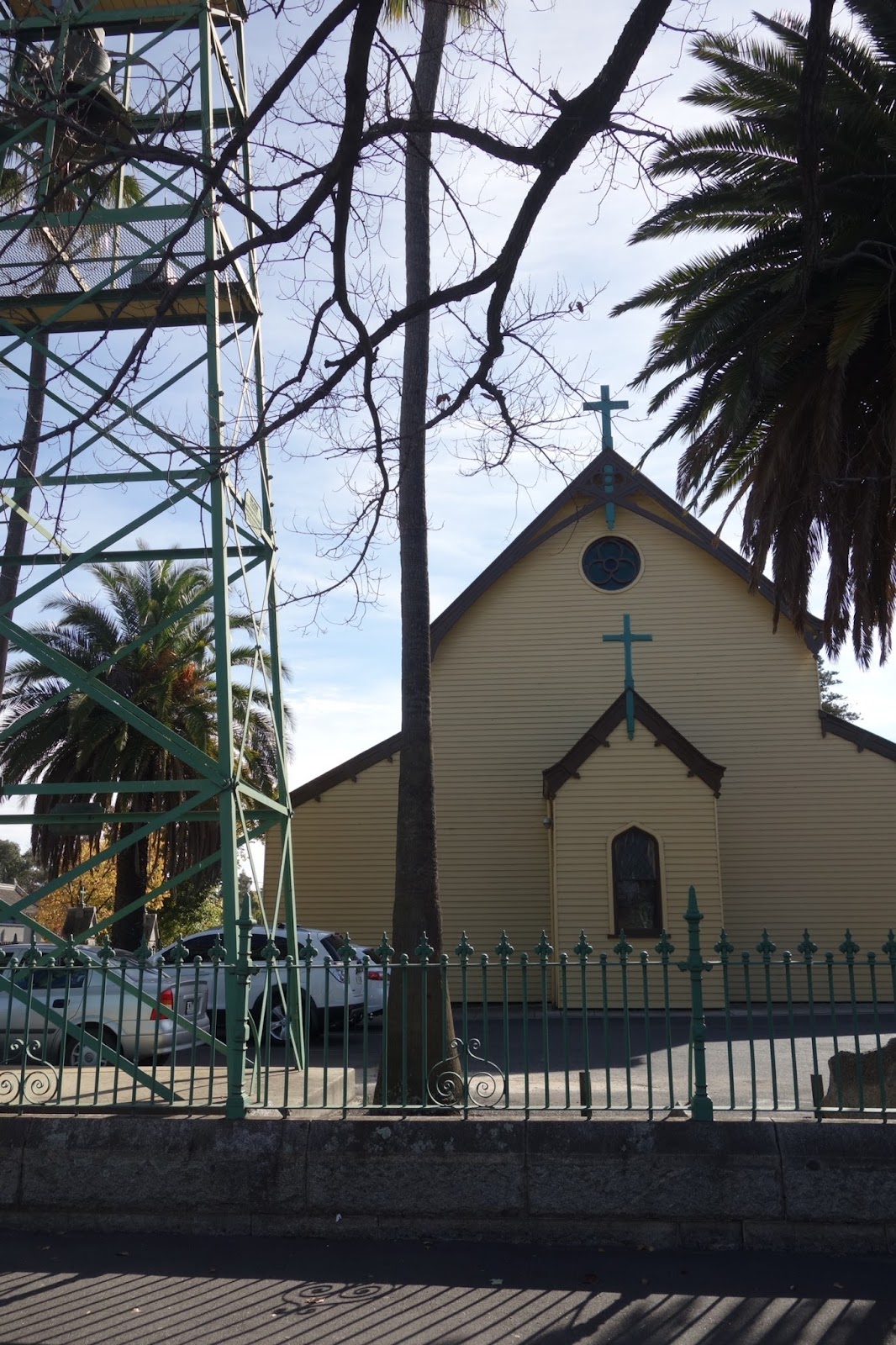
The foundation stone for a church on this site was first laid in 1856 and a stone church was built.  30 years later that building was condemned as the walls were cracking and crumbling and a 'temporary' weatherboard structure was built in 1888.  That temporary structure still stands today, and St. Killian's Catholic Church is considered to be the largest wooden church in the Southern Hemisphere.


The gaol here in Bendigo was built between 1859 and 1862.   It was a medium security prison and most of the prisoners were assessed as suitable for treatment in the area of substance abuse and addictive/compulsive behaviours.  Accommodation was mostly in single cells, with a small number of shared cells. The prison was officially closed in January 2006.


Camp Hill Primary School was built in 1877 and the fire brigade used the tower as a look out for many years until a reliable telephone service was installed.


Dudley House, built in 1859, is the first permanent District Lands and Survey Office and is the oldest surviving ex-governmental office in Bendigo, and is a fine example of the gold era architecture.


This historical Fire Station was built to house the Bendigo Fire Brigade in 1896.


The Masonic Temple and Hall was built in 1874 and its 18 metre high portico is supported by six 10m tall Corinthian columns.  Nowadays the building is known as "The Capitol" - Bendigo's Performing Arts Centre.


The Penfold's Building was built in 1879 for the distinguished Dr. Oliver Penfold.  Dr. Oliver Penfold, the grand old man of Bendigo, and Dr. Christopher Rawson Penfold of Penfold's Wines were cousins.


Temperance Hall was built in 1895 for the Temperance Movement.


The Sandhurst Trustees Building was built in 1869 and it was the very original post office of Sandhurst which operated until 1887.


Alexandra Fountain is a landmark in Bendigo situated centrally on the most prominent intersection in the city.  Built as a symbol of the rapid development and consequent wealth of Bendigo as a result of the successful gold fields during the second half of the nineteenth century, Alexandra Fountain is a good example of late Victorian ornamental exuberance.   It was named after Alexandra, Princess of Wales whose sons, Princes Albert and George, attended the opening ceremony in 1881.


The original Beehive store was built in the mid 1850s, replaced by a two storey building in 1864 and then razed by fire and replaced by the present building in 1871.  The first floor housed the Gold Exchange and brokers' offices.


The building on the left is the original National Bank, built in 1887.   When the National and Colonial Banks merged, the National Bank moved next door into the former Colonial Bank building, also built in 1887.


The Shamrock began life in 1854, as a small hotel known as The Exchange Hotel, servicing miners during the gold rush.  The hotel's patronage quickly grew with the booming goldfields and it was renamed the Shamrock in 1855.  It was rebuilt for the first time in 1864 and then this building in 1897.   Dame Nellie Melba was one of the notable guests of the hotel during the Edwardian era, she stayed in the third floor corner suite opposite the Bendigo Post Office clock tower and demanded its hourly chime be turned off.  Prince Charles and Princess Diana also stayed here during a royal visit in 1983.


The original town hall building was built in 1858, but then in the early 1880s one of the city's most influential architects transformed the Bendigo Town Hall into this grand building.


While I was out walking I also came across this piece of public art which I particularly loved.  It's called "After the Procession" and was made to commemorate the Easter Parade and Fair held every year in Bendigo.


And to give you a bit of an arial view of Bendigo, I climbed up a poppet head tower which is located near to the CBD area of Bendigo and it affords a great view out over the city.


Quite a nice little city is Bendigo - and I'm looking forward to learning more about it over the next couple of days.

Sunday, 5 May 2013

My last (deep sigh) weekend in Wodonga

Yes I certainly have done some good eating and wine drinking with friends this weekend, but in between the eating and drinking I've also had the chance to do a few things.

Beechworth is a little town of great historical significance, about 40kms south/west of Wodonga.  In 1852 gold was discovered in Beechworth and the wealth from the gold rush built Beehworth and its nationally significant buildings.  Over four million ounces of gold were found between the years 1852 to 1866, which is worth several billion dollars in today's currency.  Miners of all nationalities flocked to the Ovens Goldfield (Beechworth), however there was also a realization that the gold would not last forever, and this made for substantial investments in public services.  Many of the buildings in Beechworth were constructed during the 1850s and 1860s and still stand and continue to be utilized today.  Beechworth is now only one of two towns in Victoria classified as "notable" by the National Trust, with over 30 local buildings on the Trust's register.

So what follows now is a little tour of Beechworth for you, and to get you started, here is Beechworth's main street:


The Post Office was first completed in 1859 however, following a fire along the street it was rebuilt in 1867.  The Post Office played an important role in communicating news in 1880 of the murders of police at Stringybark Creek and the various exploits of the Kelly gang.


The foundation stone for the Beechworth Methodist Church was laid in 1857 - previous to that services had been held in the open air, and then in tents, since 1852.


This beautiful church with stained glass windows dedicated to early parishoners was built in 1858 and the tower and chancel added in 1864.  The organ was installed in 1887 and it is the only 19th century pipe organ in North East Victoria.  Christ Church is also the only country parish in Victoria, and only the third in Australia, to have a ring of bells.


What is now the present Parish Hall for Christ Church was actually the original church.  Built in 1855, the lower (right-hand) side of the building was the original Church of England Grammar School and it was here that Isaac Isaacs, later to become the first Australian born Governor General, did his first schooling.  A few months later, the upper section of the building was added (the left-hand part of the building) and this was the first Anglican Church in Beechworth.


Nearby is the Gothic-style St Joseph's Roman Catholic Church, built in 1868, with its fine rose window and interior granite columns.


This wonderful building was formerly the Brigidine convent of Mt. St. Joseph.  In 1886, four Brigidine Nuns left Ireland to sail to Australia.  The Sisters immediately set about establishing a convent, and this was the second Brigidine Convent to be established in Australia.  The Sisters took over the permanent charge of St. Joseph’s school in 1887 and in the same year purchased ten acres of land adjacent to the school.  Stage one of the new convent and secondary school was begun there in 1887.  The next few years saw much building and in 1904 a substantial new wing was complete.  During it’s history the convent averaged 80 pupils, 30 of these being boarders, reaching a peak of 150 pupils in the 1960’s.  The school closed in 1978 and now the Old Priory is B&B accommodation as well as a conference centre.


There is a section within Beechworth known as the Beechworth Historic and Cultural Precinct.  This group of provincial public buildings strongly reflects Beechworth's former place as the administrative centre of the north-east during the late 1850s and 1860s, and as a prosperous gold mining town.  All the buildings were erected between 1856 and 1859 from local honey granite.

The Telegraph Station was build in 1858 and this building was a key point of communications throughout the district.  It was the main connection hub from regional centres to Melbourne and Sydney.  Today you can still send morse code messages around the world.


Beechworth Historic Courthouse is one of the finest remaining Gold Rush courthouses in Australia.  Built in 1858 the Courthouse served many judicial purposes until its closure in 1989.  The courtroom was the scene of countless trials involving Ned Kelly, his mother Ellen, bushranger Harry Power and Elizabeth Scott (the first woman hanged in Victoria).


Originally built as the Gold Receiver's Office and Sub Treasury (to the Melbourne Treasury) in 1856, 14, 000 ounces of gold were taken by coach to the Melbourne Treasury.  In total gold worth more than $4 billion in present day prices was mined from Beechworth.  At the end of the Gold Rush the building was used as the Beechworth Police Station, which played a pivotal role during the outbreak of the Kelly Gang.


Dating from 1858, the grand Beechworth Town Hall once also housed the Shire Offices and served as a Court of Petty Sessions, linked by a staircase to the holding cells underneath.


The Chinese Protector's Office was built in 1857 in an effort to forge harmonious relations on the goldfields and was responsible for collecting miners' rights and business licenses.


HM Prison Beechworth - decommissioned in December 2004.  Originally the gaol was a series of long wooden huts enclosed by a spiked stockade.  The granite gaol was built in stages from 1858-64. It housed about 35 male and 5 female prisoners who toiled in the labour yards or at their respective trades - work of practical benefit to the town.  The gallows were built in 1865, and eight men were hanged there between 1865 and 1881. 
The prison is historically significant for many reasons, but notably for its associations with the bushranger Ned Kelly and the Kelly story.  Kelly served six months in the prison in 1870-71 for assault and was held there during his committal trial for murder in 1880.  It was also in Beechworth Prison that Kelly's mother, Ellen and two associates of the Kelly family served sentences in the late 1870s for the attempted murder of Constable Alexander Fitzpatrick.  It was this incident and the resulting convictions which are credited as being the catalyst for the so-called Kelly Outbreak.  Beechworth Gaol is further associated with Kelly as the place where twenty suspected Kelly sympathisers were held in 1879 in an attempt to limit support to the Kelly gang.  The iron gates were installed at this time as it was feared that there might be an attempt to break the sympathizers out of the prison.


The Police Stables are said to have housed horses used by the police in the hunt for the outlawed Kelly Gang.


Built in 1867 as a police lock-up, this building had a cell for both male (on the left) and female (on the right) prisoners held on remand before court appearances.  It is believed that both Ned Kelly and his mother Ellen were held here prior to their trials. 


Just outside the town of Beechworth there is a gorge through the surrounding hills which is also home to many of the creeks where gold was originally found.


And then just as we were leaving a mini 'parade' started as part of the "Drive Back in Time" event that was happening in Beechworth this weekend.  Given the historical significance of Beechworth, seeing these cars on the road was a perfect match for the ambience of the day.


The drive back to Wodonga is a great example of what the countryside in north-east Victoria is like - this is overlooking the Indigo Valley.


Approximately 25kms east of Wodonga is the Hume Dam.  It is a major gated concrete gravity dam with four earth embankments and twenty-nine vertical undershot gated concrete overflow spillways across the Murray River.  The dam's purpose includes flood mitigation, hydro-power, irrigation, water supply and conservation. The impounded reservoir is called Lake Hume.  The Hume Dam was constructed over a 17 year period between 1919 to 1936.


Lake Hume is estimated to hold approximately six times the volume of water in Sydney Harbour.


The lake is stocked with fish and so it's also home to pelicans.


Driving back to Wodonga and I saw one of the biggest mobs of kangaroos I have ever seen!  There were probably at least 100 kangaroos, if not more, in this paddock.  And if you look closely at the second photo, you can see that the kangaroo on the right is a mummy with her joey in her pouch.


As I've said, the weather has changed and we're definitely into fall here in Australia now.  Although fall colours like we get in Canada are not as common here it's not impossible to find some wonderful colours.


Thursday, 2 May 2013

Back in Melbourne for a couple of days

Just a very short post today, but I did want to say "hi" and assure everyone that I am still around.

I left South Australia after my weekend in the Clare Valley and came back to Melbourne.   I haven't done very much the past few days - hence why this is a very short post.  I've spent some time organizing my belongings ... and doing a lot of shopping!

It definitely is fall/autumn here now, and given that Melbourne is in the southern part of Australia it is cooler here.  That being said, "cool" is relative, especially to a Canadian.  Daytime temperatures are still usually around 20 degrees C, but it is falling to single digits overnight now, and so that definitely gives the days that touch of fall.

Today my 'to do' list took me to Queen Victoria Market - a place that has been the heart and soul of Melbourne for more than a century.  The Queen Victoria Market opened in 1878, and at around seven hectares is the largest open air market in the Southern Hemisphere.  The Market is significant to Melbourne's culture and heritage and has been listed on the Victorian Heritage Register.  The Market is named after Queen Victoria who ruled the British Empire from 1837 to 1901.  This vibrant and bustling inner-city Market is where Melburnians shop for everything from Australian fruit and vegetables, and local and imported gourmet foods, to cosmetics, clothing and souvenirs.


After my shopping I did a bit of walking and came across this wonderful old building.  The Melbourne City Council opened the first Melbourne City Baths in 1860, which housed public baths. The objective was to stop people from bathing in the Yarra River, which by the 1850s had become quite polluted and the cause of an epidemic of typhoid fever which hit the city resulting in many deaths.  However, people continued to swim and drink the water - and lack of maintenance resulted in such deterioration of the building that the Baths were closed in 1899.  The baths were redesigned and reopened in 1904.  Strict separation of men and women was maintained, right down to separate street entrances.  Two classes of facilities were maintained, with second class baths in the basement and first class baths on the main floor.  The popularity of the swimming pool increased with the introduction of mixed bathing in 1947.  Today, The Baths now house a swimming pool, spa, sauna, squash courts and a gymnasium.


If you think way, way back to when I first arrived in Melbourne you might remember from one of my posts at that time a building called the Royal Exhibition Building.  What I didn't show you in that post (it was turned off for cleaning) was the absolutely gorgeous fountain located out in front of the Exhibition Building.  This colossal fountain, built in 1880, stands ten metres high and was constructed for the first of Melbourne's two grand international world fairs.  The fountain's visual elements were designed to display the young colony's confidence and advancement, simultaneously signalling the purpose of world fairs to display the produce and industry of nations.  At the central level of the fountain, four youths (representing a young and vibrant colony) dance below symbols of the arts, science, commerce and industry; for example, musical instruments, a telescope, sailing ship, steam engine and globe of the world.  Above this are images of Victoria's indigenous flora and fauna, and a boy with a clamshell.  Holding all of this aloft are four merpeople rising up from the waters of the lower pool.


I'm back to Wodonga again for this weekend --- so if there's another few days before the next post you'll know that I'm enjoying good food and wine with good friends.