Tuesday, 16 April 2013

Back to the Barossa ... and somewhere new!

It took awhile, but finally my feet did come back to the ground after my glider flight, and I found myself back in the Barossa the next day.  Seppeltsfield is one of Australia's oldest wineries, founded in 1851 by Joseph Ernst Seppelt.  Located on the grounds of the winery is the Seppelt family Mausoleum, built in the style of a Greek Doric temple.  Members of the Seppelt family have been interned at the mausoleum since the original generation that started the winery.


Winter Creek and Torbreck Wineries were two other stops on the agenda today.  I especially liked the cellar door (and the wines too) at Torbreck Wineries, which is a converted old homestead building.


Another stop today was at Maggie Beer - a Barossa food tradition.  Maggie and her husband Colin established the Barossa Pheasant Farm Restaurant in 1978.  The restaurant became known for serving pheasant (which was raised locally) as well as a pate known as Pheasant Farm Pate (which is delicious!).   Currently, Maggie operates a business in the Barossa which produces a range of gourmet foods, including Pheasant Farm Pate, quince paste, verjuice and ice creams.  For those who are interested you should check out her website:  www.maggiebeer.com.au   All I can say is: "yummy, yummy, yummy".
At the Maggie Beer property there is a lovely little dam you can walk around,
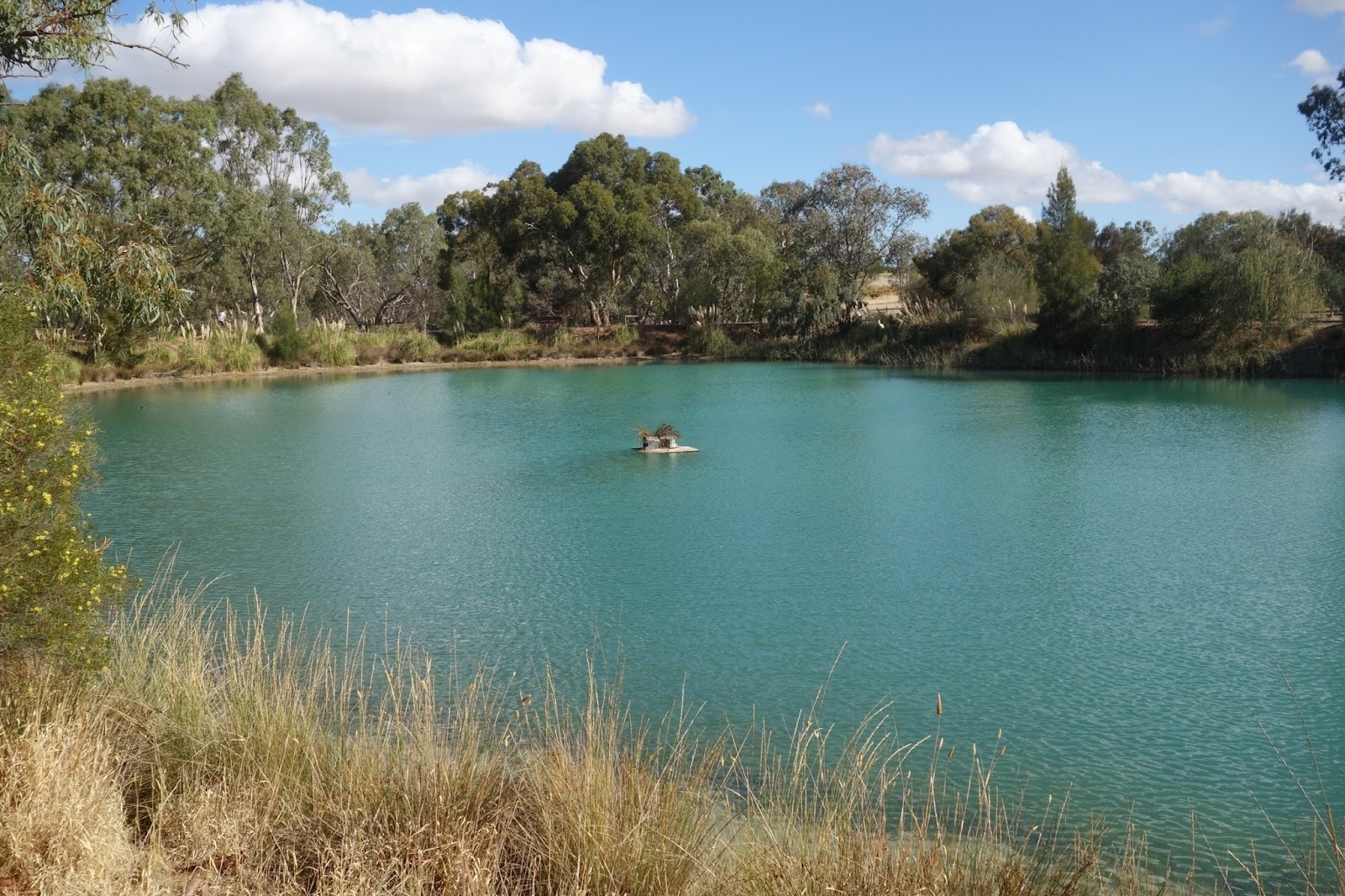


and while you are walking you can also see where the grapes and olives are grown for all the Maggie Beer products.  Definitely a good example of something from the Barossa!


And then on Monday it was time to start out on my next adventure --- to Kangaroo Island.

Kangaroo Island is Australia's third-largest island.  It is a part of South Australia, 112 kms south-west of Adelaide at the entrance to Gulf St. Vincent.  Its closest point to the mainland is 13 kms off Cape Jervis on the tip of the Fleurieu Peninsula.  The island is 150 kms long and between 57 kms and 90 kms wide, its area covering 4,405 km2.  Its coastline is 540 kilometres long and Kangaroo Island has a current population of approx. 4500 people.   Flying or by ferry are the only two ways of getting to Kangaroo Island, and so after about a 4 hour drive from Waikerie I arrived at the ferry terminal at Cape Jervis.  The ferries that make the crossing are all passenger and vehicle carrying catamaran style vessels, and the crossing takes about 45 minutes.


I had a bit of time to go for a little walk up from the ferry terminal and take a look up the coast of the Fleurieu Peninsula.


Our crossing was at 6:00pm, and since Australia is no longer in daylight savings time it was beautiful timing as the sun was just starting to set --- and it peeked out from behind the cloud bank too.


Given the timing of the ferry crossing, the drive from where we landed at Penneshaw (on Kangaroo Island) to where I'm staying was in the dark, so I was quite eager to get up this morning and see what awaited me.  And this is my view...


Emu Bay, where I'm staying with friends, is located on the north coast of Kangaroo Island.  It is a small village of just under 100 property allotments with what seems to be a fairly even mix of permanent homes and cottages.  The village has no shops - the nearest place for shopping is Kingscote which is about 20 kms away.  Emu Bay is known as a popular swimming beach, and is one of only a couple on Kangaroo Island where vehicles are permitted.

After spending a good amount of time this morning sipping my coffee and enjoying the view, I went for a walk around Emu Bay.


Even though I'm on an island, and walking along the beach, you can tell the countryside is still very, very dry.  This is a close-up of the rocks right on the beach. 

You can see the little village of Emu Bay on the other side of the bay.

Just over 40 kms west of Emu Bay is Stokes Bay.  It's really interesting to get to Stokes Bay because you have to walk though a cliff "tunnel" 


which opens up onto a beautiful, picturesque beach.


There is some very hearty - and beautiful - vegetation at Stokes Bay too.

Historic Wisanger School was Kangaroo Island's first school.  It was built in 1884 and continued to be used for teaching until 1945.


Back at Emu Bay and I decided to wander back down to the beach and jetty to say 'hi' to some of the locals.


And then back at my friend's house and what should be snuggled up in the eucalyptus tree in their yard but the cutest little koala!


I can't wait to see what's on the agenda for tomorrow!

Saturday, 13 April 2013

Another tick on the bucket list ---- GLIDING!

Well I certainly didn't expect to be writing this post but the opportunity presented itself and I couldn't say no!

You might remember from my posts when I was previously in Waikerie that there is a gliding club that operates from here, and today I had the chance to go up in a two-seater glider.  As you'll see in the photos, it was a slightly overcast day so I didn't think the gliders would actually be going, but going they were and I was there.

I'll let the photos tell the story...

"My" glider 

The tow plane

Buckling up and giving me my instructions 

Attaching the tow plane

And we're off... 


In flight, looking down on Waikerie, The Murray River, and the South Australia countryside in the Riverland area:


Not that we used the airstrip, not for taking off or landing, but here it is from the air 


Looking down on the houseboats on the Murray River

Eventually though all good things must come to an end, and it was time to land:


I think I had a good time ... what do you think?


So now I can tick something else off my bucket list ... and I would definitely go again if I have the opportunity.

(And a special thank you to my friend who came with me this afternoon and obviously took some of the photos.)

Friday, 12 April 2013

Hello again to Waikerie

As I mentioned in my last post, the blog isn't seeing quite so much activity right now as I'm continuing to revisit places I've been to previously in my travels.  That will change in the next little while though as soon I'll be heading out to somewhere totally new so please do stay tuned for some more 'adventures'.

In the meantime though, I spent a couple more days in Wodonga after our visit to Rutherglen.  Since I've been treating you to some photos of "big things" that Australia is proud of, I thought you might like to see the "big thing" that Wodonga is famous for ... the World's Largest Rolling Pin which is found on the roof of a very good bakery!

And another thing which makes Wodonga special --- not everywhere has "Sesame Street"!


Before leaving Wodonga I went up to a lookout to overlook Wodonga and the surrounding hills.  It was very, very hazy as several controlled burns had been happening in the area over the weekend and the smoke hadn't yet dissipated.


I left Wodonga last Monday and spent Tuesday in Melbourne (basically running around getting errands done) before an early morning flight on Wednesday back to Adelaide.  A coffee on Rundle Mall and then I was off on the bus back up to Waikerie.

On Thursday I got to visit the school where a friend of mine is principal - it was a reciprocal visit as my friend had been to visit me and my school a couple of years ago.

Her school was originally founded in 1913 and so this year the school will be celebrating its centenary.  The original building is still on site, but unfortunately over the years a much newer building was built onto the front of the original sandstone building and so now the only place you can really see the old building is from the back (sorry about all the lovely air conditioners in the photo).


This school is a lovely contrast of "old" and "new".  A couple of years ago every school in Australia was given money by the federal government under a scheme called "Building Education Revolution" (BER).  Although the schools were of course happy to get the money, the plan was probably less about education and more to stimulate the building industry, and the money had to be used to either build a new building or renovate an older one.  So my friend's school now has an amazing new gymnasium.


This is the original school bell from when the school was founded in 1913.


I think the thing I loved best about this school though was the Library.  Several years ago the school bought an old Lutheran Church that was next door to the school and incorporated it into the school grounds.  Renovations and additions to the original church building have happened over the years and now the space is an absolutely lovely Library and research learning centre.


Yesterday I went for a little walk along the Murry River bank... just to get my dose of that lovely scenery.


Saturday, 6 April 2013

Can you believe it - Cheryl's at a winery

My apologies everyone - and thank you to everyone who has emailed to make sure I'm okay - I know I've been a bit slack with my blog postings recently.  I am absolutely fine --- just spending some time going back to places I've been before and spending lots of time catching up with friends, chatting, eating nibblies, and drinking wine.

After leaving Brisbane and the Gold Coast I flew back to Melbourne and was there for Easter weekend.  Unexpectedly the Easter Bunny paid a visit to me there and for the next week I was enjoying some very delicious chocolate-mint treats!

Then last Tuesday I came back to Albury/Wodonga.  It's school holidays here right now and since my friends don't have to go to work right now it's been great to spend this time with them.

I'm not sure if I mentioned it when I was first here in Albury/Wodonga, but there is a wine region very nearby here called Rutherglen - and Rutherglen is where I found myself today (along with a couple great friends!).
Rutherglen is located west of Wodonga - about a half hour drive away.  The area around Rutherglen was originally settled in 1836 by a number of squatters, and then within weeks of the initial gold strike in 1860 thousands moved to the settlement.  Although it was gold which drove the initial thrust of immigration, it is wine which has made Rutherglen famous today.  The first planting of grapes for wine in the district was undertaken by John Lindsay Brown in the 1850s and more vineyards followed.  By 1890 Rutherglen was producing a quarter of Australia's wine.
Today Rutherglen is one of Australia's oldest wine regions with families that founded Rutherglen still making wine in the region today.
The wineries in Rutherglen are particularly noted for their full-bodied reds (in particular their shirazes and durifs) as well as their sweet fortified wines (muscats and tokays).


From my very first visit to Rutherglen (over 17 years ago now) I knew I would love this wine region.  After all, when the town's "emblem" is a giant wine bottle you have to know you're in a pretty good place.


So I spent today visiting some of the wineries here and puttering around the town of Rutherglen a little bit ... in other words having a really great time.

My first stop today, Campbell's Wines, is one of the oldest wineries in the Rutherglen region.  It was established in 1870 and today brothers Malcolm and Colin are the fourth generation to carry on the Campbell tradition.


Another stop today, Scion Vineyard and Winery, is one of Rutherglen's newest wineries, establishing itself on an old vineyard site which produced award winning wines a century ago.  And a decade after their first vine plantings Scion is winning its own awards.


Our last stop for the day was at one of my most favourite wineries - Morris Wines.  Morris Wines was established in 1859 and the family pioneered the growing of durif in the region.  They have a long tradition of producing full-bodied red wines with long cellaring potential and magnificent fortified wines.


One has to admit that driving around Rutherglen and in and out of the wineries wasn't a hard way to spend the day at all!!